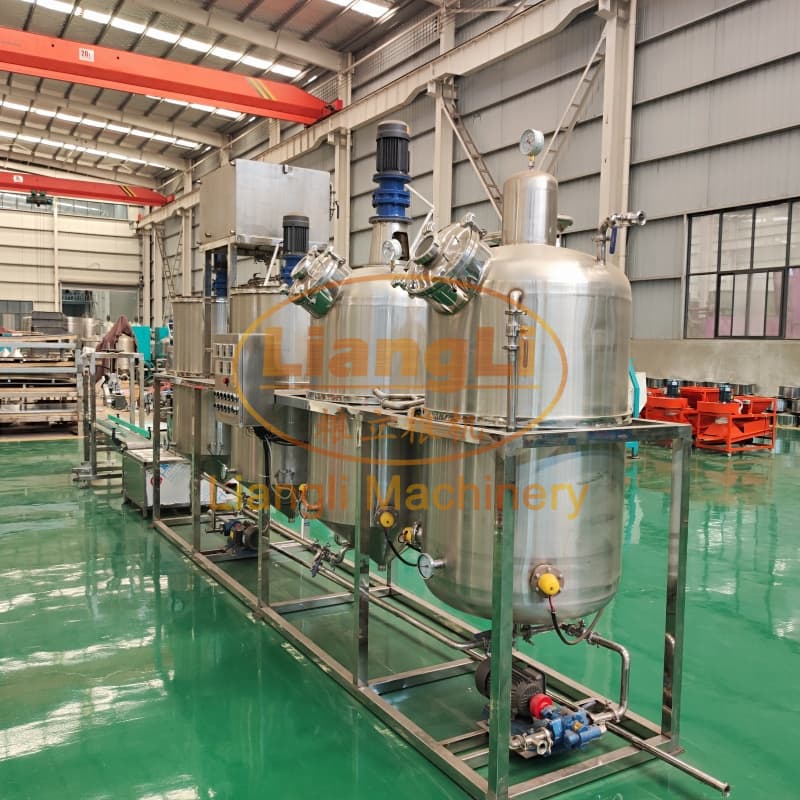
Palm oil fractionation is a core physical process used to separate the various components of palm oil based on their differing melting points. This process yields products with distinct melting characteristics, making them suitable for diverse applications across food processing, chemical manufacturing, and the catering industry. The entire production line features a high degree of automation and ensures process stability.
1- Raw Material Pre-treatment
Refined crude palm oil is conveyed to raw material storage tanks, where it undergoes precise temperature-controlled preheating to disrupt existing crystal structures within the oil. Simultaneously, a filtration system removes residual impurities, ensuring the purity of the oil and laying a solid foundation for the subsequent crystallization stage.
2- Tempering and Crystallization (Core Process)
The oil enters crystallization tanks, where it is slowly cooled and agitated according to a pre-programmed sequence. By strictly controlling both the cooling rate and agitation speed, the process encourages the gradual formation of uniform, stable crystals from the high-melting-point stearin components, while the low-melting-point olein components remain in a liquid state, thereby achieving a preliminary separation of the oil’s constituents.
3- Crystal Maturation
Upon completion of the crystallization phase, the mixed oil is transferred to maturation tanks for a period of static holding at a constant temperature. This allows the crystals to fully grow and aggregate, optimizing their morphology and size to enhance the efficiency of the subsequent solid-liquid separation and prevent crystal fragmentation that could compromise fractionation accuracy.
4- Solid-Liquid Separation
Utilizing vacuum filters or mechanical pressing equipment, the solid stearin is efficiently separated from the liquid olein within the crystallized mixture. The solid fraction constitutes palm stearin, while the liquid fraction becomes palm olein.
5- Palm Olein Processing
The separated palm olein undergoes precision filtration and heat exchange to remove any trace crystal residues. Once quality-tested and approved, it is conveyed to finished product storage tanks, ready for direct use in cooking, food manufacturing, and related fields.
6- Palm Stearin Processing
The palm stearin is melted via heating and subjected to purification treatments before being stored. It is suitable for various applications, including the production of margarine, shortening, soap, and industrial lubricants.