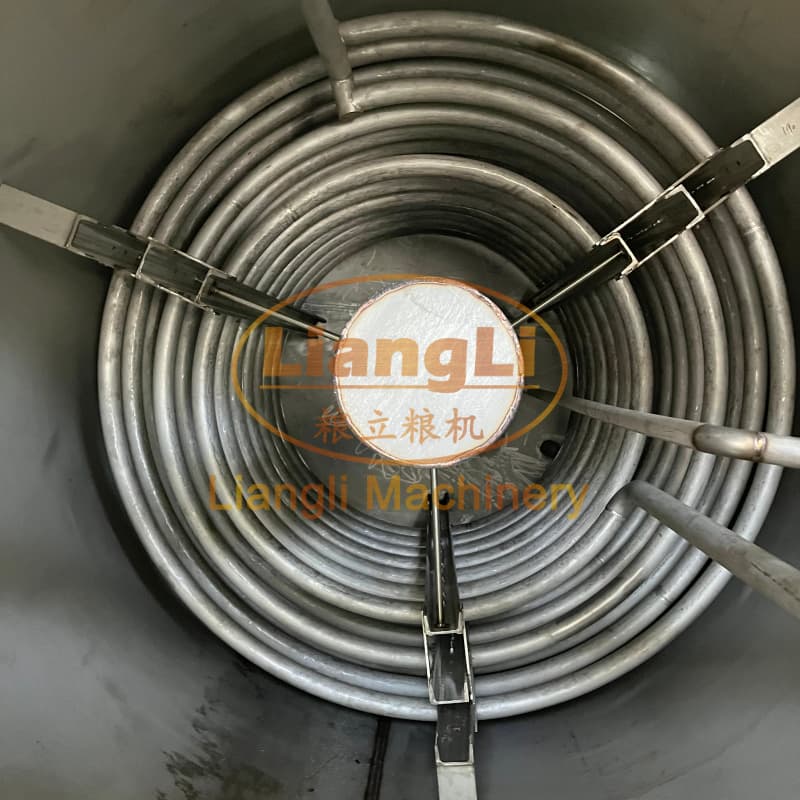
The 5TPD palm oil refining system employs a small-scale, intermittent refining process. The entire operation is conducted in batches using a single refining vessel, specifically designed for small-capacity, workshop-style palm oil processing operations. It is suitable for refining both crude palm oil and crude palm kernel oil.
Complete Process Flow :
1- Pre-filtration and Impurity Removal
The crude palm oil is first passed through a plate-and-frame filter press to remove mechanical impurities—such as sand and fibers—present in the raw material. This step prevents interference with subsequent refining stages and serves to preliminarily enhance the clarity of the oil.
2- Degumming Process
The oil is heated to a temperature of 75–85°C, at which point phosphoric acid or hot water is added in precise proportions and thoroughly mixed.
This process destabilizes colloidal impurities, causing phospholipids and other gummy substances to coagulate and settle out.
After a period of settling to allow for phase separation, the resulting “oil foot” (sediment) is removed, thereby completing the degumming stage and ensuring the efficacy of the subsequent alkali refining process.
3- Deacidification (Alkali Refining)
Based on the acid value of the palm oil, the required amount of caustic soda is calculated. With the oil temperature maintained between **60–75°C**, the alkali solution is added to neutralize free fatty acids. After mixing to facilitate the reaction, the mixture is allowed to settle; the reaction between the fatty acids and the alkali produces a soapstock precipitate. The soapstock is then separated and removed, followed by washing the oil 2–3 times with hot water to eliminate residual soapstock and salts. Finally, the wash water is separated from the oil via centrifugation or settling.
4- Decolorization Process
Under a vacuum environment, the oil temperature is raised to 100–110°C. Activated bleaching earth is then added to adsorb pigments, residual soapstock, and other impurities. Since palm oil naturally possesses a relatively deep color, the dosage of bleaching earth must be carefully controlled. After mixing to facilitate adsorption, the spent bleaching earth is separated using a filter press, yielding decolorized oil that meets the required color standards.
5- Deodorization Process
The decolorized oil is transferred to a deodorization vessel, where a high-vacuum environment is established. The temperature is raised to 240–250°C, and direct steam is injected for stripping. This process removes odor-causing substances, residual free fatty acids, and peroxides from the oil. Upon completion, the oil is cooled under vacuum to produce the final refined palm oil product.
6- Final Filtration of Finished Product
The cooled, finished oil undergoes a final precision filtration step to remove any trace impurities before being packaged and stored.